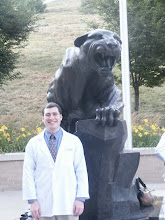
So after a month at the VA, now I start down the hill at Montefiore. This promises to be a widely different experience for a number of reasons. For example, in a couple hundred hours spent at the VA, my team admitted exactly one female patient, whom I did not take care of. Thus, I haven't done a history and physical on an adult female since...jeez, since Ob-Gyn (aka the worst rotation in medical school). It'll be interesting to see how this goes. Also, attitudes tend to be very different at Monty vs. the VA. While there were a few vets who were tough to get along with, it really was only a few. Most of them are wonderful for a medical student to work with because they let us try things (like the I&D -- that's "incision and drainage" for the non-medical folk in the audience -- I performed on a relatively large abscess the other day), they forgive mistakes, and they don't blame the doctors if they choose not to follow medical advice. Oh, and they also tell really great stories sometimes. We'll see, but I think those things are likely to be scarce in Monty. On the other hand, I hear that my team is pretty good and my teaching attending is a doc I've known since the first day of medical school, so I'm cautiously optimistic.
Before embarking on the second half of this rotation, though, I need to write about one patient to close the door on the first part. One guy I took care of was a spry old fellow in his early/mid 80s who'd been having left lower quadrant abdominal pain for a number of weeks. He finally "made the mistake" (his words, although jokingly) of telling his wife who insisted that he come to the ED. "I thought they'd give me some pills and send me home," he said. Well, there aren't too many things that cause LLQ pain in an adult male, so the ED doc got a CT scan which showed hydronephrosis (a swollen, obstructed ureter). The radiologist thought there might be a pyelonephritis (kidney infection), but the urologists disagreed. The guy had blood in his urine, they said, and it looked to them like he had a hematoma in his kidney that was gumming up the works. So he was admitted to our service for workup and monitoring until urology could stick a scope up there to see what was going on. It didn't seem all that concerning. If he had an infection, we'd hit him with ciprofloxacin (an antibiotic) until we could get cultures back; if he had a hematoma, urology would take care of it when they scoped him. Except it didn't turn out that way. Two days later my resident got a call from the urologist. After she hung up, she turned to me. "He has cancer. Transitional cell carcinoma. It was all over the pathology." I asked if she wanted me to tell him. Fortunately I had an awesome resident -- she shook her head. "It's not your job. If you want, we can go together." So I went upstairs while she ran a quick errand, but Murphy's Law being what it is, I immediately ran into the veteran's wife. Apparently she had already heard from the urologist, but all she had gotten was "It's cancer" before the uro guys were whisked away to their next case. She was understandably distraught and had numerous questions that I tried to answer. After a few minutes my resident found me, answered the rest of the wife's questions, and then gathered everyone in the patient's room to break the news to him. He dealt with it surprisingly well, but it was still the first time I'd ever had to be part of a conversation to deliver such an unexpected and frightening diagnosis. I'm sure it won't be the last. Fortunately, my resident provided me with a terrific example of how to go about delivering bad news that I'll hopefully be able to draw on in the future. Also of note, we initially expected a pretty grim prognosis based on what urology had seen. It looked like a high-grade cancer, and we feared that it would also be high-stage. But when we did our staging, it didn't appear to have spread even to the local lymph nodes -- potentially a very good sign. So we'll see what happens, but at least the outlook isn't as bleak as we originally thought. Prayers for him would be very much appreciated.
Anyhow that's all for tonight. If I'm not on long call tomorrow, I'll post about my first day at Monty in the evening. Till then, peace and God bless!
Showing posts with label cancer. Show all posts
Showing posts with label cancer. Show all posts
Sunday, January 30, 2011

Thursday, September 16, 2010
Gyn Onc
I'm exhausted to the point of incoherence, so this will of necessity be brief. Gyn onc is, in some ways, a sad but fitting bookend to the experiences of labor and delivery. In L&D, the patients are new mothers and their children as they make the transition from "unborn" to "born." Every day is an encounter with the miraculous; every day is filled with lives just starting out. In gyn onc, however, the spectre of death is very real. One quick story for purposes of illustration. Prior to heading into the OR for her surgery, I quickly met and introduced myself to the next patient on the schedule. MRI had shown an endometrial cancer in her uterus, and the uterus needed to be removed to ensure clear margins. She had been scheduled for a laparoscopic hysterectomy, and since she was nulliparous (no children) and hadn't had any prior abdominal surgeries, it figured to be a quick and easy case.
Of course, Linakis's First Law (coined by my father) states that "the plot ALWAYS thickens" and this case failed to become the first known exception to said law. I had scrubbed in and was watching the procedure. The attending was saying that it probably wasn't going to turn out having been worth scrubbing for; he correctly pointed out that during a laparoscopic procedure you can generally see as much from halfway across the room as you can with your hands on the operating table. Less than five minutes after he made that comment, he finally located the uterus among all the abdominal adipose tissue. It should have been normal-looking. It was not. A large gray-white tumor was clearly protruding from the top of the uterus. Immediately things became more serious. This was no longer a quick and easy procedure that could be done laparoscopically. She needed a laparotomy; that is, her belly had to be fully cut open so that we could go searching to see whether the cancer had spread. Still, though, we were hopeful; if this protruding tumor was an isolated lesion, the patient's odds would still be pretty good. That optimism lasted an even shorter time than the laparoscopic attempt. When we opened her abdomen, we found small, nodular tumors everywhere. Her omentum (a large fat pat in the belly) was liberally spotted with metastatic disease. The colon appeared to be involved. And all of a sudden, the once quick and easy case had turned into a nightmare. Don't know who had to discuss our findings with the patient, but I'm glad it wasn't me. Please keep her in your prayers tonight; the prognosis is (obviously) pretty poor.
Anyway, that's it for me. It's time for bed; up at 4 tomorrow to start work at 5. Yay. Oh well, at least I have a good team! Back with more updates in the evening. Till then, peace and God bless!
Of course, Linakis's First Law (coined by my father) states that "the plot ALWAYS thickens" and this case failed to become the first known exception to said law. I had scrubbed in and was watching the procedure. The attending was saying that it probably wasn't going to turn out having been worth scrubbing for; he correctly pointed out that during a laparoscopic procedure you can generally see as much from halfway across the room as you can with your hands on the operating table. Less than five minutes after he made that comment, he finally located the uterus among all the abdominal adipose tissue. It should have been normal-looking. It was not. A large gray-white tumor was clearly protruding from the top of the uterus. Immediately things became more serious. This was no longer a quick and easy procedure that could be done laparoscopically. She needed a laparotomy; that is, her belly had to be fully cut open so that we could go searching to see whether the cancer had spread. Still, though, we were hopeful; if this protruding tumor was an isolated lesion, the patient's odds would still be pretty good. That optimism lasted an even shorter time than the laparoscopic attempt. When we opened her abdomen, we found small, nodular tumors everywhere. Her omentum (a large fat pat in the belly) was liberally spotted with metastatic disease. The colon appeared to be involved. And all of a sudden, the once quick and easy case had turned into a nightmare. Don't know who had to discuss our findings with the patient, but I'm glad it wasn't me. Please keep her in your prayers tonight; the prognosis is (obviously) pretty poor.
Anyway, that's it for me. It's time for bed; up at 4 tomorrow to start work at 5. Yay. Oh well, at least I have a good team! Back with more updates in the evening. Till then, peace and God bless!
Subscribe to:
Posts (Atom)